Namaste Nepal
A 5-Day Language Guide for European Travelers
Easy • Practical • Respectful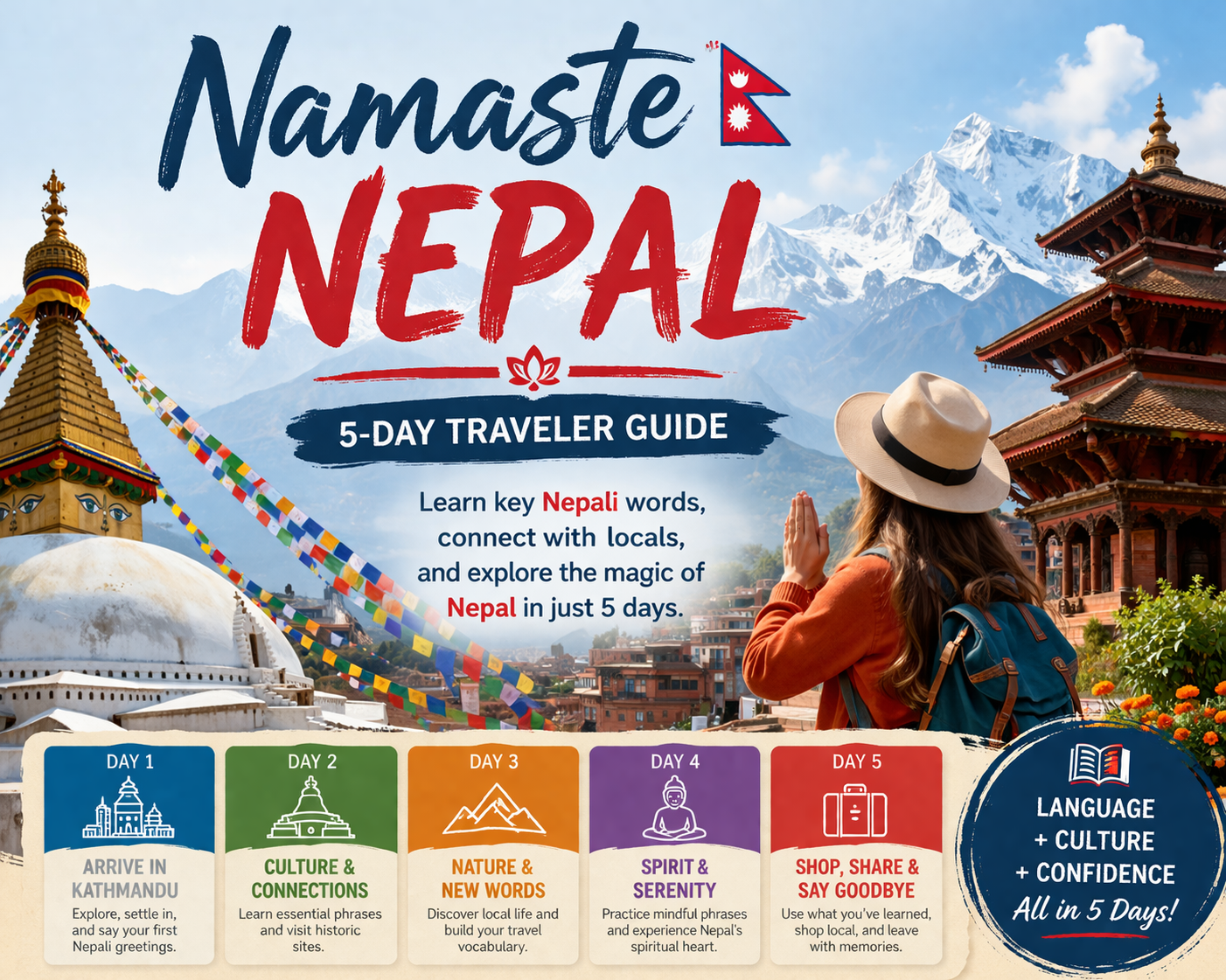
Why Nepali is Different?
For European speakers, the logic of Nepali is reversed. While you say "I drink water," in Nepal you say "I water drink." Always put the action (verb) at the end!
| Feature | English Logic | Nepali Logic |
|---|---|---|
| Sentence Order | Subject + Verb + Object | Subject + Object + Verb |
| Respect | "You" is for everyone | "Tapai" (Polite) vs "Timi" (Casual) |
| Asking | Where is the bus? | Bus where is? |
Day 1: Greetings & The Respect System
Level: BasicIn rural Nepal, starting with Namaste and a slight bow shows you respect the local culture deeply.
| Context | English | Nepali (Devanagari) | Phonetic (Pronounce) |
|---|---|---|---|
| Greeting | Hello / Goodbye | नमस्ते | Na-mas-te |
| Respectful "You" | You | तपाईं | Ta-pai |
| Asking Name | What is your name? | तपाईंको नाम के हो? | Ta-pai-ko naam ke ho? |
| Giving Name | My name is... | मेरो नाम... हो | Me-ro naam... ho |
| Gratitude | Thank you | धन्यवाद | Dhan-ya-baad |
| The Magic Word | Yes / Pardon / OK | हजुर | Ha-jur |
Day 2: Needs & The "Malai" Rule
Level: SurvivalWhen expressing a feeling (hunger, thirst) or a want, we use "Malai" which means "To me."
| Context | English | Nepali | Phonetic |
|---|---|---|---|
| Hunger | I am hungry | मलाई भोक लाग्यो | Ma-lai bhok la-gyo |
| Thirst | I am thirsty | मलाई तिर्खा लाग्यो | Ma-lai tir-kha la-gyo |
| Desire | I want tea | मलाई चिया चाहियो | Ma-lai chi-ya cha-hi-yo |
| Preference | I like this | मलाई यो मन पर्छ | Ma-lai yo man par-cha |
| Location | Where is the toilet? | शौचालय कहाँ छ? | Sau-cha-la-ya ka-ha cha? |
Day 3: Moving & Shopping
Rural people are honest, but bargaining is a social game. Use "Ali kam garnus na" to ask for a friendly discount.
| English | Nepali | Phonetic |
|---|---|---|
| How much? | यसलाई कति पर्छ? | Yas-lai ka-ti par-cha? |
| It is expensive! | महँगो भयो | Ma-han-go bha-yo |
| Discount please | अलि कम गर्नुस् न | A-li kam gar-nus na |
| Stop here | यहाँ रोक्नुहोस् | Ya-ha rok-nu-hos |
| Go straight | सिधा जानुहोस् | Si-dha ja-nu-hos |
Day 4: Feelings & Safety
Important for high-altitude trekking or expressing illness in remote areas.
| Context | English | Nepali | Phonetic |
|---|---|---|---|
| Fatigue | I am tired | मलाई थकाई लाग्यो | Ma-lai tha-kai la-gyo |
| Health | I am sick | म बिरामी छु | Ma bi-ra-mi chu |
| Pain | My head hurts | मेरो टाउको दुख्छ | Me-ro tau-ko dukh-cha |
| Happiness | I am happy | म खुसी छु | Ma khu-si chu |
| Cold | I feel cold | मलाई जाडो भयो | Ma-lai ja-do bha-yo |
Day 5: The "Medium" Conversation
Make a real connection by asking about family. Local villagers will love this!
| English | Nepali | Phonetic |
|---|---|---|
| How many children? | कति जना छोराछोरी? | Ka-ti ja-na cho-ra-cho-ri? |
| The food is tasty | खाना धेरै मिठो छ | Kha-na dhe-rai mi-tho cha |
| I love Nepal | मलाई नेपाल धेरै मन पर्छ | Ma-lai Ne-pal dhe-rai man par-cha |
| I will come back | म फेरि आउनेछु | Ma phe-ri au-ne-chu |
| See you again | फेरि भेटौँला | Phe-ri bhe-tau-la |
🇳🇵 Quick Cultural Tips
- Right Hand: Always give money or food with your right hand.
- The Head Shake: A side-to-side wobble usually means "Yes" or "I am listening."
- Family Terms: Call an older man "Dai" (Brother) and an older woman "Didi" (Sister).
BARALA Web Tools & Services
Explore our most popular Nepali calculators, typography converters, and daily web utilities.